
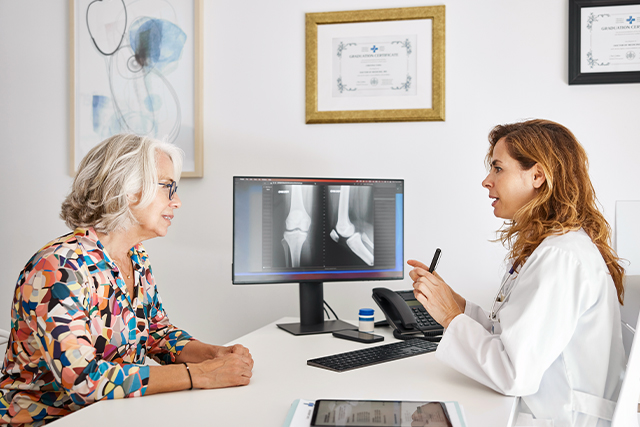
Bone health is essential for lifelong mobility, strength, and independence, but bone density and strength decrease as we age. Declining estrogen levels during and after menopause make women more vulnerable to fractures as they age since estrogen helps to maintain bone density. More than half of postmenopausal women have osteopenia, which is mild loss of bone density, and millions are at risk of osteoporosis, which is major loss of bone density. Although men can be diagnosed with osteoporosis, around 80% of cases affect women. Osteopenia and osteoporosis are “silent” because they develop without symptoms and often go unnoticed until a fracture (broken bone) occurs.
What is Osteopenia?
Osteopenia is defined as a bone density that is lower than normal. This condition isn’t as serious as osteoporosis, but it’s an early warning sign that bones may be weakening, and fracture risk is increasing. Like osteoporosis, osteopenia develops gradually as bone density naturally declines with age. This can happen earlier or progress faster with certain risk factors such as low calcium or vitamin D intake, lack of activity, smoking, heavy alcohol use, and some medical conditions. About 43 million American have osteopenia, and more than half of postmenopausal women are affected.
What is Osteoporosis?
Osteoporosis is a progressive bone disease in which the body loses too much bone, doesn’t make enough, or both. This causes bone to become fragile and more likely to fracture, usually in the hip, spine, and wrist. Osteoporosis develops when bone loss happens faster than bone formation. Bone creation slows after a person’s early 20s, and bone mass peaks by about age 30. In women, bone loss speeds up significantly after menopause due to a steep drop in estrogen, a hormone that protects and maintains bone density.
Postmenopausal women – especially those who are white or Asian– are the most at risk of developing osteoporosis. Other risk factors include family history of fractures, small body frame, long-term corticosteroid use, smoking, drinking excessive alcohol, thyroid disease, and certain cancer treatments like chemotherapy.
Screening & Diagnosis: Understanding T-Scores
The gold standard for diagnosing both osteopenia and osteoporosis is a measurement of bone mineral density (BMD). It is measured with a quick, painless X-ray called a DXA or DEXA scan (dual-energy X-ray absorptiometry). The DXA scan compares your bone density to that of a young, healthy adult. This comparison is called a T-score. A T-score between 0 and –1 is normal. Osteopenia is diagnosed when a person’s T-score is between –1 and–2.5, and osteoporosis is any score at or below –2.5. Knowing your T-score can help you and your healthcare provider make informed decisions about your health.
Guidelines recommend that women over 65 and younger women with risk factors should undergo bone density testing with a DXA scan. Healthcare providers often use T-scores along with an overall fracture-risk assessment to guide decisions about treatment, monitoring, and preventive steps. Early diagnosis offers the best opportunity to slow bone loss before it progresses, and before fractures occur.
Risk Factors and Prevention
General risk factors for bone loss include aging, menopause, low calcium or vitamin D intake, lack of weight-bearing or resistance exercise, smoking, excessive alcohol use, and long-term steroid therapy. Women face additional risks due to the rapid decline of estrogen after menopause and the effects of certain breast cancer treatments like chemotherapy and hormonal therapy, all of which can accelerate bone loss.
Prevention strategies are highly effective at reducing your risk of bone loss and conditions like osteoporosis, and even small lifestyle changes can reduce long-term fracture risk. Regular weight-bearing activities like walking or jogging and strength-training exercises like lifting weights help build and maintain bone density. Getting enough of the recommended values of calcium and vitamin D by eating dairy, fortified foods, dark leafy greens, and fruits is another way to keep your bones strong and healthy. Avoiding smoking and limiting alcohol can improve your bone health and overall wellbeing, too.
Treatment and Management
Management strategies depend on the condition and degree of bone loss. People with osteopenia are usually encouraged to start with lifestyle changes, although medication may be recommended if their fracture risk is elevated. For osteoporosis, medications such as bisphosphonates, hormone therapy, and monoclonal antibodies like denosumab can help slow bone loss and reduce fracture risk. Regardless of the condition, any bone loss should be monitored regularly to ensure treatment plans continue to be effective.
When to Seek Medical Advice
Routine screening can be important, but individuals should also seek medical attention if they experience a broken bone after a fall from standing-height or lower (called a fragility fracture), as this is often the first obvious sign of underlying bone weakening. You should also seek medical advice if you are concerned about your risk factors or notice height loss, posture changes, back pain, or if you are experiencing early menopause.
Key Takeaways
Osteopenia and osteoporosis are similar, but not identical. Osteopenia is early bone loss, marked by bone thinning, while osteoporosis is more advanced and classified by fragile bones and a high risk of fractures. Both conditions are common, especially in postmenopausal women, but you can reduce your risk with early action. Routine screening, nutrition, regular exercise, and knowing your risk factors are all essential components of a healthy skeleton that stays strong for life.
Sources
- Mayo Clinic Press. “Understanding Osteoporosis vs. Osteopenia.” https://mcpress.mayoclinic.org/healthy-aging/understanding-osteoporosis-vs-osteopenia/.
- Mayo Clinic Staff. “Osteoporosis.” Mayo Clinic, https://www.mayoclinic.org/diseases-conditions/osteoporosis/symptoms-causes/syc-20351968.
- Sutter Health. “Osteopenia and Osteoporosis.” https://www.sutterhealth.org/health/osteopenia-and-osteoporosis.
- Penn Medicine. “Osteopenia.” https://www.pennmedicine.org/conditions/osteopenia.
- Bone Health & Osteoporosis Foundation. “Bone Density Exam/Testing.” BHOF, https://www.bonehealthandosteoporosis.org/patients/diagnosis-information/bone-density-examtesting/.
- Harvard Health Publishing. “Osteopenia: When You Have Weak Bones but Not Osteoporosis.” Harvard Health, https://www.health.harvard.edu/womens-health/osteopenia-when-you-have-weak-bones-but-not-osteoporosis.
- Cleveland Clinic. “Osteoporosis.” https://my.clevelandclinic.org/health/diseases/4443-osteoporosis.
- Memorial Sloan Kettering Cancer Center. “Osteo: Bone Health.” PDF version, https://www.mskcc.org/cancer-care/patient-education/osteo-bone-health?msk_tools_print=pdf.

